
Japan is now in the middle of Golden Week, a series of holidays starting from April 29 and going till May 5. When I was little, May 5 was called "Boys' Day." Various foods and displays that symbolized the parents' prayers and dreams for their sons were the highlight of this festival. And even as a girl, it was exciting to be a part of of the celebrations.
Nowadays, the holiday is called "Children's Day," but the festival retains much of its masculine feel. Typical displays include old-style warrior helmets and armor. This contrasts with March 3 which is officially called "Doll's Day," and is a festival to celebrate the traditional feminine qualities that parents once wished for their little girls. The typical display is dolls dressed in the costumes of the ancient imperial court. I think both festivals are fun, and no amount of indoctrination in political correctness will change that.
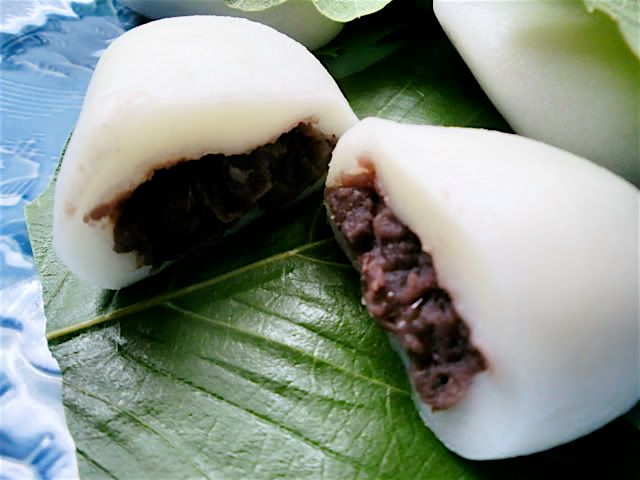
One of the sweets traditionally associated with Boy's Day/Children's Day is Kashiwa Mochi. A Dictionary of Japanese Food by Richard Hosking defines it thus: "Round shaped mochi filled with an and wrapped in an oak leaf. It is especially eaten on May 5, Children's Day (formerly Boys' Day), the symbolism being that oak leaves do not wither." (p.74)
Here is a recipe from Denshi Renji de Kantan Wagashi (easy Japanese sweets made with a microwave oven) by Matsui Michiru:
Ingredients:
smooth an (koshi-an, sieved sweet red bean paste)....200 grams
non-glutinous rice flour (johshinko)......200 grams
water............................280 cc
oak leaves.....................8
Directions:
1. Divide the an into 8 portions of equal size and roll each portion into a ball.
2. In a microwave-safe dish, place rice flour and water, mixing them well.
3. Cover the dish and heat in microwave for 4 minutes. Remove dish from microwave, mix contents again, and microwave for 3 more minutes.
4. Remove the dough from the dish and wrap it in a clean, moistened kitchen towel. With the dough wrapped in the towel, knead the dough until it is smooth.
5. Moisten your hands with water and divide the dough into 8 equal portions, pressing each portion gently into an oval shape. Place one an ball in the middle of each dough oval. Fold the dough over the the an ball, sealing the edges .
6. When the dough has cooled, fold an oak leaf over each of the an-wrapped dough balls.
These freeze well. Defrost at room temp when you're ready to serve them.


